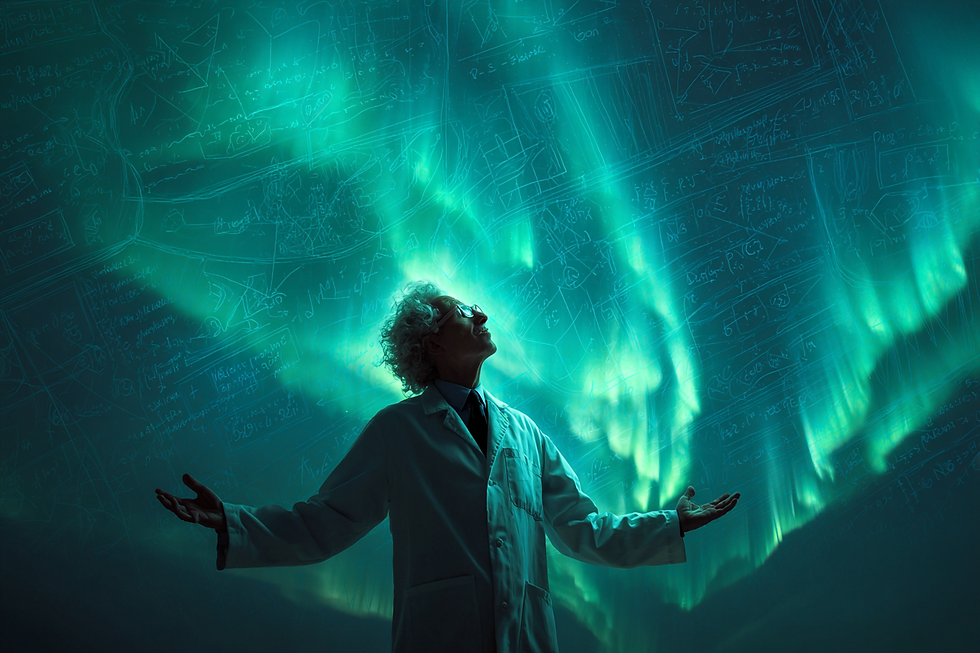


What Are the Northern Lights?
The Northern Lights — or Aurora Borealis — are perhaps the most enchanting natural wonder you can witness in the Arctic sky. To many, they look like magic: ribbons of green, curtains of violet, bursts of pink or even rare flashes of red. But while the sight is dreamlike, the explanation lies in physics, astronomy, and Earth science. In this post, we’ll peel back the layers of the aurora, from its origins on the Sun to the exact mechanisms that create those glowing colors in the night sky.

The Aurora’s Origins: A Gift From the Sun
Everything starts with our star, the Sun. Far from being a calm ball of light, the Sun is a turbulent sphere of plasma, constantly boiling and erupting. Its outer atmosphere, called the corona, reaches millions of degrees Celsius. At such high temperatures, hydrogen and helium atoms lose electrons, creating a soup of charged particles — a plasma.
Solar Wind: These charged particles are continuously streaming outward into space, forming the solar wind. The solar wind typically travels at 400–800 km/s (that’s more than 1 million mph).
Magnetic Storms: When the Sun experiences solar flares or coronal mass ejections (CMEs), massive amounts of plasma and magnetic fields are ejected. These storms can reach Earth in 1–3 days, causing particularly strong auroras.
Energy Transfer: Each second, the Sun loses around 1 million tons of matter in the form of solar wind. A fraction of that makes its way to Earth, colliding with our protective shield.
So the Northern Lights are essentially a byproduct of Earth’s encounter with solar energy that has traveled 150 million kilometers across space.
Earth’s Magnetic Field: The Invisible Stage
Why don’t all planets have auroras? The secret lies in Earth’s magnetosphere.
Magnetosphere Basics: Earth behaves like a giant bar magnet, with field lines looping from the South Pole to the North Pole. The solar wind compresses this field on the dayside and stretches it into a long tail (the magnetotail) on the nightside.
Auroral Oval: Where magnetic field lines funnel charged particles into the atmosphere near the poles, we get the so-called auroral oval — a doughnut-shaped zone where auroras are most frequent. Tromsø sits right inside this oval, which is why auroras here are so common.
Particle Acceleration: As solar wind particles interact with Earth’s magnetosphere, they are accelerated along magnetic field lines into the upper atmosphere, where the light show begins.
Without this magnetic shield, Earth’s atmosphere would be stripped away by the solar wind, just like what likely happened to Mars billions of years ago.
The Physics of the Glow: Collisions in the Atmosphere
When charged solar particles smash into our atmosphere, they collide with atoms and molecules of oxygen and nitrogen. These collisions excite the atoms, giving their electrons extra energy. When the electrons return to their normal state, they release photons — tiny packets of light. Multiply this by trillions, and you get the aurora.
Oxygen:
At 100–250 km altitude, oxygen emits the familiar green light (557.7 nm wavelength).
Above 250 km, oxygen produces a red glow (630.0 nm), which is much rarer because the air density is low and collisions are less frequent.
Nitrogen:
Molecular nitrogen produces blue light at lower altitudes.
Ionized nitrogen molecules emit purples and pinks, often seen at the edges of the aurora curtains.
The exact mix of gases, altitude, and energy determines the aurora’s color palette.
The Aurora Oval
The Aurora Oval is a donut-shaped zone around Earth’s magnetic poles where auroral activity is most common. It expands and contracts depending on solar activity, but Tromsø lies right under this oval, making it a prime spot for sightings. This means that even when the solar activity is relatively low, chances of seeing the lights here are still very high compared to other parts of the world. The oval typically hovers around 65–72 degrees latitude, so northern Norway, northern Canada, Alaska, and parts of Greenland and Iceland are all in perfect viewing range.

Why Are Auroras Stronger Around the Equinox?
Statistically, auroras are more frequent and more vivid around March and September. This is due to the Russell–McPherron effect, which describes how Earth’s tilt and the orientation of the interplanetary magnetic field (IMF) make it easier for solar wind energy to couple with Earth’s magnetosphere during equinoxes.
In simpler terms: around the equinox, Earth’s magnetic field is lined up in just the right way to let more solar wind energy in. That’s why September is such a special month for aurora hunters in Tromsø.
The Role of the Solar Cycle
Auroras follow an 11-year solar cycle:
Solar Maximum: During peak activity, auroras are more frequent, brighter, and visible further south (sometimes as low as Scotland or northern U.S.).
Solar Minimum: Fewer storms, but auroras don’t disappear entirely — especially not in Tromsø, which is so far north it sits right under the auroral oval.
We are currently approaching Solar Maximum in 2025, which means the next few years are among the best in decades to see the Northern Lights.
When and Where to See Them in Tromsø
Season: Late August to mid-April. In summer, the Midnight Sun keeps the skies too bright.
Time of Night: Between 9 pm and 2 am, but they can appear any time it’s dark.
Best Spots: Outside Tromsø city lights. Fjords, mountains, and islands like Kvaløya offer perfect dark skies. That’s why guided tours often drive for hours — chasing breaks in the cloud cover.
Fun Facts You Might Not Know
Auroras don’t just occur on Earth. Jupiter, Saturn, Uranus, and Neptune all have auroras, some even stronger than ours, thanks to their massive magnetic fields.
During strong storms, auroras can extend as far south as Mexico (last recorded in 1958).
The aurora can also affect technology: disrupting satellites, GPS, and power grids. The most famous case was the Carrington Event of 1859, when telegraph systems worldwide failed due to a massive solar storm.
Some people claim to hear auroras — faint crackling or rustling sounds. While controversial, Finnish scientists recorded unusual sounds during strong auroras that may support the idea.
Why Tromsø Is the Perfect Aurora Destination
Geography: Tromsø is right in the auroral oval. Your chances of seeing the aurora here are higher than in most Arctic locations.
Climate: Thanks to the Gulf Stream, Tromsø’s winter temperatures are milder than inland destinations at the same latitude.
Accessibility: Tromsø is a vibrant city with restaurants, hotels, and culture — yet only a short drive from complete wilderness and dark skies.
Expertise: Local guides have spent years reading the skies, chasing clear weather, and maximizing your chances.
The Northern Lights are a cosmic handshake between our planet and the Sun — a reminder of how deeply connected Earth is to space. Every flicker of green, every burst of purple, every rare streak of red is a story of solar particles traveling millions of kilometers, funneled by Earth’s magnetic field, and painting the sky in light.
In Tromsø, you’re not just watching a natural phenomenon — you’re watching the Earth breathe with the Sun.
So the next time you stand under the Arctic sky, bundled against the cold, and the heavens ignite in glowing ribbons, you’ll know: this is science, this is nature, and this is magic.